Welcome to IbexHuntSpain World. On our website you will find the complete details of all the different adventures we can put at your disposal.IbexHuntSpain will make your hunting dreams come true, and you can rely on our team of professionals to attend to all your requests.
Enjoy hunting ibex in Spain in their natural rugged environment, where you are surrounded by our ancient mountains and unforgettable landscapes.
Showing posts with label hunting audad in spain. Show all posts
Showing posts with label hunting audad in spain. Show all posts
I
am writing with regarding to Valeriano Belle´s . In September 2011
I was hunting under Valeriano’s guidance in the Spanish mountains Gredos
for Ibex Gredox. While achieving the highest possible standard of work,
I saw many examples of his numerous talents and was impressed by his
diligence and work ethic. I would like to take this opportunity to
recommend Valeriano
During
my time with him as my outfitter, Valeriano proved himself to have
outstanding outfitter and hunter skills. He was able to successfully
organize the whole trip for me as a hunter and my two sons as observers.
He planned the trip to the smallest possible detail from finding a
highly comfortable accommodation and taking us to special local
restaurants to guiding me in the mountains to the best possible Ibex.
This hunting trip was a major undertaking, requiring a great deal of
thought and effort on Valeriano´s behalf.
Spain has the largest variety of big game trophy animals in all of Europe.
IBEXHUNTSPAIN
hunts in the best private high quality trophy areas, as well as in
the Spanish National Game Reserves. Here are all the different
wildlife animals which are hunted in Spain. You can get different
information about them.
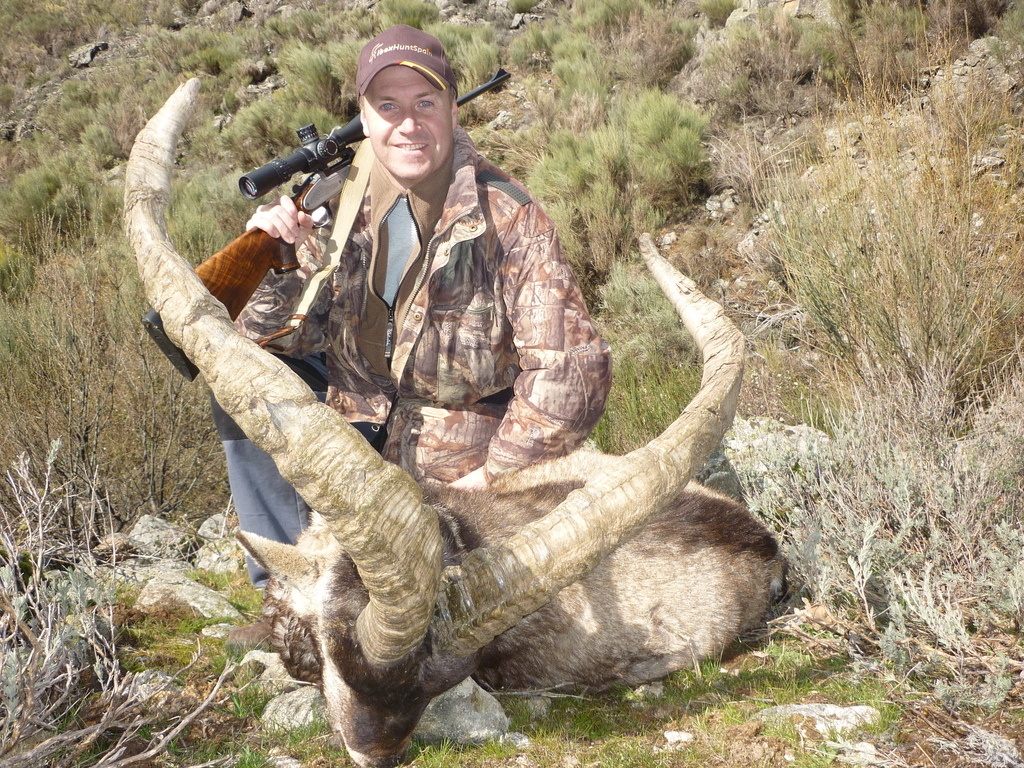
Gredos Ibex
Gredos Ibex CHARACTERISTICS
Male’s horns are big, wrinkled and ringed, they rise vertically and lean out and back in a lyre form with the top inwards.
GEOGRAPHIC RANGE
Central Spanish mountains (Sierra de Gredos).
Beceite Ibex
Beceite Ibex CHARACTERISTICS
Male’s horns are big, wrinkled and ringed, rise vertically and lean out
in a very open way; they have plane form with the tips up.
GEOGRAPHIC RANGE East Spanish mountains (Puertos de
Tortosa-Beceite Natural Park and Maestrazgo) near the sea, where the
weather is very mild, although this does not prevent from forming of a
rough and rugged landscape where the hunter can fully enjoy the hunt in
his pure state.
Ronda Ibex
RONDA IBEX CHARACTERISTICS Ronda male’s horns are shorter, grow straight and their end have a sheep form.
GEOGRAPHIC RANGE South Spanish mountains. The Ronda Ibex is hunted in Antequera, Zona Costera and Sierra de las Pedrizas, in Andalucia province.
South East Ibex
South East Ibex CHARACTERISTICS
Sierra Nevada male’s horns grow long and follow an extraordinary backward curve that reminds a sheep form.
GEOGRAPHIC RANGE
South Spanish mountains. The Sierra Nevada
(South East) Ibex is hunted in the mountains of Sierra Nevada National
Park, in Sierra de Lujar, Sierra de Huetor, Santillan, and Sierra
Arana, in Andalucia province.
Balear Goat
Balear GoatCHARACTERISTICS
Balear goat also known as Mallorca’s wild goat is internationally
recognized as a homologated hunting trophy by the International Safari
Club and the local Balearic Government : GOVERN DE LES ILLES BALEARS. Its coat is short and bright, brown-reddish with black stripes on the rear of the body and black legs.
Both sexes have horns, but only the horns of the
males grow spirally being long and thick. Horns of the females are
parallel and curved. Only males show a long black beard. Females with
young and males live in separate groups and males approach the female
group only during the mating season.
GEOGRAPHIC RANGE
North Mallorca mountains (Sierra Tramuntana y ArtA) and
peninsular East mountains.
North mountains of Mallorca (Sierra Tramuntana ) and Peninsula of Formentor.
PYRENEAN CHAMOIS
PYRENEAN CHAMOIS CHARACTERISTICS
PYRENEAN CHAMOIS, ISARD (RUPICAPRA PYRENAICA PYRENAICA).
Takes the name from the spectacular Pyrenees Mountains between France
and Spain and boasts a considerable population. Their horns, of the
shape of a hook, constitute an attractive trophy, being one of the most
elusive mountains animals.
GEOGRAPHIC RANGE
Its habitat is in the North-East of Spain, in the Pyrenees Mountains
Its habitat is the Cantabrian Mountain Rage in the North of Spain.
This chamois bears many similarities with its cousin, the Pyrenean
chamois, but it is slightly smaller, with morphological differences
that are difficult to distinguish at first glance.
We have an exclusive hunting area over 25,000 ha. in the Province of Leon
GEOGRAPHIC RANGE
Its habitat is the Cantabrian Mountain Rage in the North of Spain
Mouflon Sheep
MOUFLON SHEEP CHARACTERISTICS The Mounflon sheep was introduced in Spain form the Island of Corsica
at the end of the 19th century. This animal has outstanding eyesight,
making its hunting very exciting. The Mouflon likes to live in heads,
usually lead by a big ram. Magnificent Mouflon trophies, capable to
make dreams come true of many sheep hunters, can be taken in Spain.
GEOGRAPHIC RANGE
Mediterranean Territory and National Parks.
BARBARY SHEEP
BARBARY SHEEP CHARACTERISTICS
The Barbary sheep, also known as Aoudad or Arrui,
is a horned sheep native from North Africa. His coat is sandy-brown,
darkening with age, with a slightly lighter underbelly and a dark line
on the back. This colour blends perfectly with the rocks of the
habitat where it lives. The coat is very thick. Throat, chest and
frontal legs have shaggy, long and smooth hair. The horns have a
triangular cross section, curved first outwards, then backwards and
finally inwards and reach up to 30 inches (76 cm) in length. The
horns are smooth with wrinkles at the base. Aoudads form herds of
adult males an females guided by a dominant male. Old males and
pregnant females are solitary. Well suited to the mountain desert
environment, they are extremely agile, jumping from stone to stone and
climbing steep inclines. In the evening they descent to the sparsely
vegetated valleys to fee
GEOGRAPHIC RANGE
The Barbary sheep lives in the mountains of Almeria and Murcia, in Eastern Spain.
SPANISH FALLOW DEER
SPANISH FALLOW DEER CHARACTERISTICS
The common coat colour is brown with white spots on the back and a
black tip at the end of the tail. Winter colour is darker. There are
albino colour fallow deers. Does and fawns live in herds while males
live in smaller groups. During the rut bucks spread out forming
harems and fighting furiously for its control. Fallow deer are grazing
animals and prefer habitat in mixed woodland and open grassland. Only
bucks carry antlers. These are broad and shovel like, growing in size
with age.
GEOGRAPHIC RANGE : All national territory in wooded areas.
All national territory in wooded areas.
SPANISH REED DEER
SPANISH REED DEER CHARACTERISTICS
The Spanish Red deer is one of the largest deer species. In winter its
coat is rough and thick of a grey-brown colour and a darker yellowish
rump patch. In summer the coat is reddish-brown. Only stags have a
thick neck and carry antlers. They start to grow in spring and are
shed at the end of winter. Antlers grow huge with a rough surface and
in case of the largest stags, the fourth or fifth tip form at the end a
basket. Red deer usually stay in same sex group for the most of
the year. During the rut, mature stags fight for the control of the
harems. Rival stags challenge opponents by belling and walking side by
side. If neither stag backs down, a crash of antlers can occur,
sometimes causing serious injuries. Only mature stags hold a harem and
during that time they rarely feed, loosing up to 20% of the body
weight.
GEOGRAPHIC RANGE All National Territory and National Parks.
WILD BOAR
WILD BOAR CHARACTERISTICS
Wild boar is found all over Spain. This animal game can be taken while
you are hunting on other species, but special hunts can be arranged
also. The best way to hunt it is waiting for it in its feeding areas
at night, when these animals are the most active. We have territories
which due to their special characteristics boast extensive wild boar
populations and therefore provide the best opportunities to obtain
great trophies. Wild boar hunting in driven hunts (10 or 15 hunters)
is the most popular way of hunting on this animal among Spanish people.
GEOGRAPHIC RANGE
All National Territory.
ROE DEER
ROE DEER CHARACTERISTICS The Roe Deer is a relatively small deer, with a body
length of 3.1–4.4 ft, a shoulder height of 2.1–2.5 ft, and a weight of
33–66 lb. It has rather short, erec antlers
and a reddish body with a grey face. Its hide is golden red in
summer, darkening to brown or even black in winter, with lighter
undersides and a white rump patch; the tail is very short 0.8–1.2 in,
and barely visible. Only the males have antlers. The first and second
set of antlers are unbranched and short or 2.0–4.7 in, while older
bucks in good conditions develop antlers up to 8–10 in long with two or
three, rarely even four, points. When the male's antlers begin to
regrow, they are covered in a thin layer of velvet-like fur which
disappears later on after the hair's blood supply is lost. Males may
speed up the process by rubbing their antlers on trees, so that their
antlers are hard and stiff for the duels during the mating season.
Unlike most cervids
Once again I meet with my friend Valeriano, I was hunting with for a big ibex in Tortosa Beceite last year. We go to a hunting area Ibexhuntspain has in the east of the country, which is known to be inhabited by a big number of Barbary sheep. We arrive almost at night and we stay in one hunting house in the same hunting area. By the way it’s really beautiful and luxury building with huge trophies decorating the walls. The cooks are already waiting for us with a delicious supper prepared, during which we talk and drink a good Spanish wine.
The next morning we have to get up early. We load the pick-up with everything necessary for the whole day of hunting and we leave almost at daybreak as Valeriano wants to check one area, where different groups of animals have a habit to come to eat almost at night. Thus we could catch them unaware from the high of the slope. After having made few miles among the wood of Mediterranean pines we start to walk up a small mountain. We lean out in silence from one side of the ravine. Soon despite a little light we can distinguish a movement of the animals among the trees. And indeed in a moment we see a group of sheep. They are very quite and we can locate a big male in the middle. Valeriano concentrates on it and observes it through a telescope. In a short time he comments it’s a good specimen and I can hunt it, but to approach we need to come down few yards without making any noise as at this time of the day the animals are very alert and it’s easy to fail to come closer unnoticed.
We come down the groove of rocks and what a bad luck, some of the stones dislodge and make enough noise. The herd of sheep group together with big male in the middle. Now it’s impossible to shoot any of them. In little time they get more nervous and run away among the pines.
We come back to a car to change the area to one more mountainous. We charge the backpacks on our backs and we start to walk searching a new group of animals. All the time the way goes up and up. Finally we are high up on the mountainside, from where we have an amazing sight of the magnificent landscape. I can make out an extensive forest, which riches the edge of a small river. Valeriano and the guide observe the mountains in the north and in few minutes they notice a group of Barbary sheep. Once again I’m full with hope and for a moment I forget about how exhaustive am I.
After one hour of walking we lean out of a big cliff. The animals are some 170 yards away. I prepare to aim, but I don’t see the animal Valeriano and the guide indicate me. The group of the sheep hears us talking and they start to move, in a few seconds we loose them among the pines and rocks. We have failed again. These animals are very elusive.
We continue walking among a spectacular landscape. I feel myself a little bit dishearten, but Valeriano assures me that soon we will find a good herd and right now it might be a good idea to get our strength back having a short meal, resting a little and than continuing to hunt. So we do it this way and once again I find myself walking.
Finally my preys are listened as we locate another group big enough. It is in the other side of the forest situated below our feet. We move silently and we find a good position so the animals can’t see us nor hear neither smell.
We are 218 yards away and I have a good support for the gun. I’ve put two backpacks between the rocks, in this way I’m quite comfortable and I feel sure. Valeriano locates a chief of a herd. He gives me indications to recognize the animal. This time I detect it straightway. It’s a magnificent male with big horns. It seems to be hidden among the females, but as it moves slowly finally I can see its full body. Its hair in the chest reaches the ground. It’s spectacular. I follow it with a cross of sight reflected in its body. I’ve already told Valeriano I will shoot but I continue waiting to get a better position of the animal and to relax to do not fail a shot.
The silence is disturbed by a deafening noise and a moment of waiting is over. I see how it fails down suddenly on a ground meanwhile the rest of a herd runs away. Valeriano screams from joy and shakes my hand. It’s so sensational.
We cross the ravine and we approach to the shot zone where we can see a magnitude and a beauty of this great Barbary sheep. It has big horns, very thick ones and its hair is very long. We make a photo and video session. The occasion is really worth it.
So once again I want to point out a big professionalism of Ibexhuntspain and a great work of its manager Valeriano Belles and his team.