Showing posts with label hunting chamoix in spain. Show all posts

Friday, 1 August 2014

BECEITE IBEX HUNT | IBEXHUNTSPAIN.ES


David A. Colwell. January 2013 -  Beceite ibex


Date: January 7, 2013


I hunted with Valeriano Belles of Ibex Hunt Spain in January of 2012 for Spanish Ibex. He runs a very efficient and ethical hunting program. His hunting camp was well organized and equipped. Valeriano is excellent at judging the trophy size of mature males and his trophy preparation and paperwork for shipment overseas is perfect. The fact that he speaks and understands English is a bonus, making the trip run very smoothly for U.S. citizens.


I highly recommend Valeriano for  your hunts..

Further questions ? Phone: 907-486-1700 or email: dcolwell@gci.net.
I am, David A. Colwell, D.V.M.
1214 Father Herman St.
Kodiak, Alaska, 99615


BECEITE IBEX | IBEXHUNTSPAIN.ES 


Wednesday, 5 September 2012

News Letters | September | Spanish big game | Hunting Ibex in Spain with IbexHuntSpain.com


Spain has the largest variety of big game trophy animals in all of Europe. IBEXHUNTSPAIN hunts in the best private high quality trophy areas, as well as in the Spanish National Game Reserves. Here are all the different wildlife animals which are hunted in Spain. You can get different information about them.


Gredos Ibex


Gredos Ibex CHARACTERISTICS

Male’s horns are big, wrinkled and ringed, they rise vertically and lean out and back in a lyre form with the top inwards.

 GEOGRAPHIC RANGE
 
Central Spanish mountains (Sierra de Gredos).


Beceite Ibex


 Beceite Ibex CHARACTERISTICS

Male’s horns are big, wrinkled and ringed, rise vertically and lean out in a very open way; they have plane form with the tips up.


 GEOGRAPHIC RANGE
 
East Spanish mountains (Puertos de Tortosa-Beceite Natural Park and Maestrazgo) near the sea, where the weather is very mild, although this does not prevent from forming of a rough and rugged landscape where the hunter can fully enjoy the hunt in his pure state.


Ronda Ibex


RONDA IBEX  CHARACTERISTICS 
 Ronda male’s horns are shorter, grow straight and their end have a sheep form.

GEOGRAPHIC RANGE
 
South Spanish mountains. The Ronda Ibex is hunted in Antequera, Zona Costera and Sierra de las Pedrizas, in Andalucia province.


South East Ibex


South East Ibex CHARACTERISTICS


Sierra Nevada male’s horns grow long and follow an extraordinary backward curve that reminds a sheep form.


GEOGRAPHIC RANGE 
South Spanish mountains. The Sierra Nevada (South East) Ibex is hunted in the mountains of Sierra Nevada National Park, in Sierra de Lujar, Sierra de Huetor, Santillan, and Sierra Arana, in Andalucia province.


Balear Goat 


Balear Goat CHARACTERISTICS

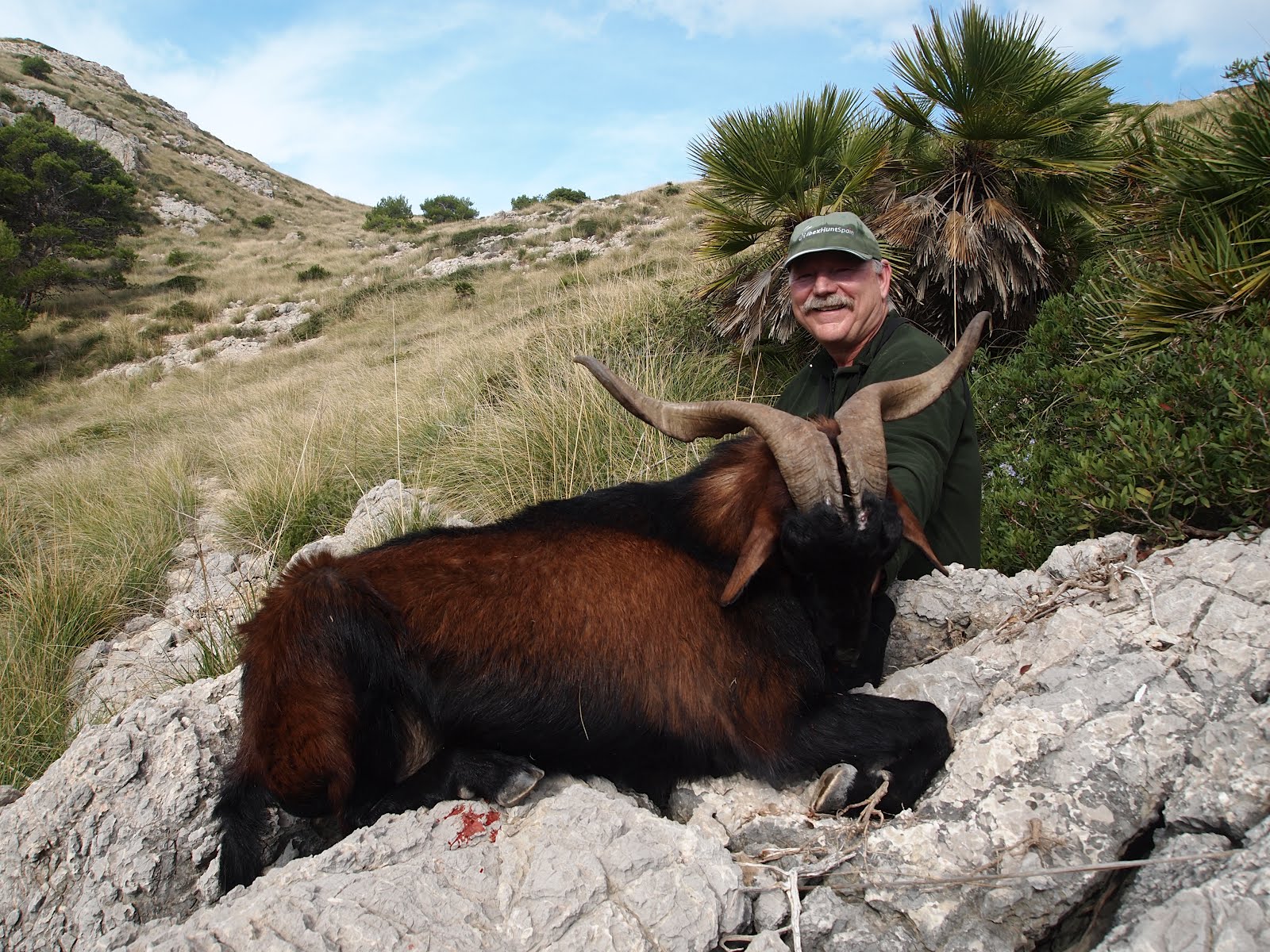
 Balear goat also known as Mallorca’s wild goat is internationally recognized as a homologated hunting trophy by the International Safari Club and the local Balearic Government : GOVERN DE LES ILLES BALEARS. Its coat is short and bright, brown-reddish with black stripes on the rear of the body and black legs.
Both sexes have horns, but only the horns of the males grow spirally being long and thick.  Horns of the females are parallel and curved.  Only males show a long black beard.  Females with young and males live in separate groups and males approach the female group only during the mating season.

 GEOGRAPHIC RANGE 

North Mallorca mountains (Sierra Tramuntana y ArtA) and peninsular East mountains. 

North mountains of Mallorca (Sierra Tramuntana ) and Peninsula of Formentor.


 PYRENEAN CHAMOIS


PYRENEAN CHAMOIS CHARACTERISTICS

 PYRENEAN CHAMOIS, ISARD (RUPICAPRA PYRENAICA PYRENAICA). Takes the name from the spectacular Pyrenees Mountains between France and Spain and boasts a considerable population.  Their horns, of the shape of a hook, constitute an attractive trophy, being one of the most elusive mountains animals.

 GEOGRAPHIC RANGE

Its habitat is in the North-East of Spain, in the Pyrenees Mountains


CANTABRIAN  CHAMOIS


Cantabrian Chamois CHARACTERISTICS
 CANTABRIAN CHAMOIS, REBECO (RUPICAPRA PYRENAICA PARVA). 

 Its habitat is the Cantabrian Mountain Rage in the North of Spain.  This chamois bears many similarities with its cousin, the Pyrenean chamois, but it is slightly smaller, with morphological differences that are difficult to distinguish at first glance.
We have an exclusive hunting area over 25,000 ha. in the Province of Leon


GEOGRAPHIC RANGE
Its habitat  is the Cantabrian Mountain Rage in the North of Spain


Mouflon Sheep 


MOUFLON SHEEP CHARACTERISTICS

The Mounflon sheep was introduced in Spain form the Island of Corsica at the end of the 19th century.  This animal has outstanding eyesight, making its hunting very exciting.  The Mouflon likes to live in heads, usually lead by a big ram.  Magnificent Mouflon trophies, capable to make dreams come true of many sheep hunters, can be taken in Spain.

 GEOGRAPHIC RANGE

Mediterranean Territory and National Parks.
 
BARBARY SHEEP


BARBARY SHEEP CHARACTERISTICS
 The Barbary sheep, also known as Aoudad or Arrui, is a horned sheep native from North Africa.  His coat is sandy-brown, darkening with age, with a slightly lighter underbelly and a dark line on the back.  This colour blends perfectly with the rocks of the habitat where it lives. The coat is very thick. Throat, chest and frontal legs have shaggy, long and smooth hair. The horns have a triangular cross section, curved first outwards, then backwards and finally inwards and reach up to 30 inches (76 cm) in length.  The horns are smooth with wrinkles at the base.  Aoudads form herds of adult males an females guided by a dominant male.  Old males and pregnant females are solitary.  Well suited to the mountain desert environment, they are extremely agile, jumping from stone to stone and climbing steep inclines. In the evening they descent to the sparsely vegetated valleys to fee

  GEOGRAPHIC RANGE

 The Barbary sheep lives in the mountains of Almeria and Murcia, in Eastern Spain.


SPANISH FALLOW DEER 


SPANISH FALLOW DEER CHARACTERISTICS

The common coat colour is brown with white spots on the back and a black tip at the end of the tail.  Winter colour is darker.  There are albino colour fallow deers.  Does and fawns live in herds while males live in smaller groups.  During the rut bucks spread out forming harems and fighting furiously for its control.  Fallow deer are grazing animals and prefer habitat in mixed woodland and open grassland.  Only bucks carry antlers.  These are broad and shovel like, growing in size with age.


GEOGRAPHIC RANGE : All national territory in wooded areas.
All national territory in wooded areas.


SPANISH REED DEER 


 SPANISH REED DEER CHARACTERISTICS


 The Spanish Red deer is one of the largest deer species. In winter its coat is rough and thick of a grey-brown colour and a darker yellowish rump patch. In summer the coat is reddish-brown.  Only stags have a thick neck and carry antlers.  They start to grow in spring and are shed at the end of winter.  Antlers grow huge with a rough surface and in case of the largest stags, the fourth or fifth tip form at the end a basket.  Red deer usually stay in same sex group for the most of the year.  During the rut, mature stags fight for the control of the harems.  Rival stags challenge opponents by belling and walking side by side.  If neither stag backs down, a crash of antlers can occur, sometimes causing serious injuries.  Only mature stags hold a harem and during that time they rarely feed, loosing up to 20% of the body weight.

 GEOGRAPHIC RANGE
 
All National Territory and National Parks.

WILD BOAR


 WILD BOAR CHARACTERISTICS

 Wild boar is found all over Spain.  This animal game can be taken while you are hunting on other species, but special hunts can be arranged also.  The best way to hunt it is waiting for it in its feeding areas at night, when these animals are the most active.  We have territories which due to their special characteristics boast extensive wild boar populations and therefore provide the best opportunities to obtain great trophies.  Wild boar hunting in driven hunts (10 or 15 hunters) is the most popular way of hunting on this animal among Spanish people.


 GEOGRAPHIC RANGE 

All National Territory.


 ROE DEER


 ROE DEER CHARACTERISTICS

The Roe Deer is a relatively small deer, with a body length of 3.1–4.4 ft, a shoulder height of 2.1–2.5 ft, and a weight of 33–66 lb. It has rather short, erec antlers and a reddish body with a grey face. Its hide is golden red in summer, darkening to brown or even black in winter, with lighter undersides and a white rump patch; the tail is very short 0.8–1.2 in, and barely visible. Only the males have antlers. The first and second set of antlers are unbranched and short or 2.0–4.7 in, while older bucks in good conditions develop antlers up to 8–10 in long with two or three, rarely even four, points. When the male's antlers begin to regrow, they are covered in a thin layer of velvet-like fur which disappears later on after the hair's blood supply is lost. Males may speed up the process by rubbing their antlers on trees, so that their antlers are hard and stiff for the duels during the mating season. Unlike most cervids

GEOGRAPHIC RANGE
 
All national territory in wooded areas.


Friday, 10 June 2011

Hunting Ibex in Spain | Hunting Spanish Ibex - 2010-2011


Hi Everybody. !
Dear friends we have finished the hunting season of Spanish Ibex 2010-2011.
It was great !! and I would like to thank all the international hunters who have joined us and the staff of Ibexhuntspain as well.


..... etc
And now we don´t stop .…
the hunt goes on …!!!


                                                          www.ibexhuntspain.com

Thursday, 4 November 2010

Pyrenean Chamois Hunting in Spain | Hunting chamois in Spain | Ibex Hunt Spain

Pyrenean chamois hunting.

The high mountains, from the point of view of a hunter, a nature’s lover like me, are so grandiose, especially when it is about the Pyrenean chamois (really magnificent animal) hunting, which in this case I consider like a unique experience.

After I have had hunted two magnificent ibexes in Sierra de Gredos; we have hired for that a hunting company Ibexhuntspain, we set out towards the Pyrenees with an illusion to hunt two chamois. The manager Valeriano Belles was waiting for us in the village to guide us in the last stretch till the hotel where we had to be accommodated. As soon as we came we went to eat and to prepare for the first contact at dusk with this immense place and its small inhabitants with horns.

First we had to wait for the local government’s forest keeper to check our licences and just after we set out in two cars towards a prey, situated at the end of a road. From there we have started the first groups of chamois in the both sides of the road, although the animals were still too far.

We’ve decided to split up into two groups. Steve and Valeriano had to go to the mountains situated in the west and me and Fernando, a guide of Ibexhuntspain, we took a way to the mountainside in the east.

Each one of us took its backpack and wished the rest to have a good luck. To tell the truth I was feeling very calm. We started to climb a steep slope full of crumbly rocks and slippery grass. Each step was an exhausting effort and together with a height and as a consequence lack of oxygen it was becoming a real torture for a body out of shape.


At last we stopped and we lied down on a ground. About lying down it’s just a manner of speaking as we were in the same vertical position as a picture hanging on a wall due to a slope of a land. During quite a lot of time we were observing a terrain through the binoculars till we have started to feel the pain in the neck as a position we were in was very uncomfortable.

After more or less one hour we have heard two shots in the far followed almost one by one. A good male has risen above us, but Fernando told me it was too far to shoot at it. A noise like the one of a distant shot makes an animal to move little by little towards a peak of a mountain. Later on we have found out that it was Steve, who was shooting at the animal, but it was too far away and he missed the first shot, as a consequence the animal raced away and it complicated a lot a second shot.

Fernando explained me that we have to go up along a rock crest and maybe we will be able to shoot the same male and in case it’s not possible we still can look at the other slope. Since the animals didn’t pass through where we were now, they should be there. Indeed, after a short but steep ascent Fernando leant out of a ledge and gave me a sign to come closer, as there were the animals eating peacefully.

In this moment my heart started to dance to the different rhythms as I was approaching. So in the same instant to lean out with a gun in one hand my heart has left behind a waltz to pass to an uncontrolled rock&roll. I took a deep breath and I put in order my thoughts trying to control a situation.


Fernando was on my left, he indicated me one chamois of a light colour eating under one rock, above it there was another darker one. I could understand what he was trying to tell me and when the moment came I’ve put a gun on a backpack I have left on the rocks. I look at a marvellous Pyrenean chamois; I was feeling that a sight was moving a little as I was nervous at this exciting moment. Without any hurry but also without making any pause I decided to lean out a little bit more so I could have a perfect position to shoot. I focused the animal; I was breathing and caressing a trigger. The bullet has come out and I knew in advance I did it I hit it. Almost immediately I saw how the beautiful male has fallen down.

I was a leading actor in my own movie; I lifted a gun, pulled the bolt back and I said: “that’s all”. At once Fernando congratulated me with killing a good Pyrenean chamois male. I thanked him and we gave each other a strong hug. We were going down through the rocks, ravines and cliffs towards the animal. We picked it up and brought it down to snowdrift. There for a moment we were discussing this great event.

We had to continue with our work. At first we took some pictures to memorize this great moment and we carried on with a butcher work taking off the skin and cutting some meat for a splendid stew, as this meat is very valued by local people.

The night caught us in the mountains. That complicated the descent through the huge tracks full of stones. I was going down slipping and trying to brake with a help of a long stick Fernando gave me. We took a shorter cut to come to a car, which was left in the prey in one side of a road a little bit more down.


In a moment we met head on with Valeriano and Steve. They were coming to search for us and to find out how did it go, as they have heard a shot.

They saw the chamois and were congratulating me making good comments. During the supper we had a great conversation. Just after we had to go to bed as the next day we had to wake up at 5 a.m. to start a new hunting for Steve’s chamois. And we did it so. It was still dark outside when we set out. We left a car in a small village from which one comes out an ancient route the local ancestors were using to get to the zone of high mountains. Using a flashlight we were walking through the craggy paths which seemed to be endless. For me the way was even harder than usually as my friend Steve passed me his backpack as light as a feather weighing more than 30 kilos (you have no idea how heavy it was).
It was amazing when after walking around one hour a day has dawned and we saw we were totally surrounded by high peaks still covered with snow.


In a moment we noticed a pair of wild boars eating in a small meadow. It took them some time to feel our presence so we could observe them thoroughly. In a few time after Valeriano perceived one chamois in a high up of a slope not too far away.

Thus Steve and Valeriano decided to go after it and me and Fernando we stayed contemplating and filming the entry into the animal’s hunting. It was a male. It was eating and it wasn’t aware of anything. They approached close enough, but it was difficult to lean out between the rocks taking out half of the body in a way that it was almost hanging over a void. Steve got ready to shoot, everything seemed to be perfect. The male was still eating. Steve didn’t look very comfortable but anyway he shot and he missed. The animal made few jumps and it disappeared between the rocks. Hunting is hunting and stress doesn’t forgive.

After walking a lot and making out different chamois in the inaccessible height, we went towards one snowdrift where there were few animals. But going up a craggy and slippery slope covered in mud we realized that in a mound at our back one chamois was watching us laid down on a rock. Valeriano observed it carefully and said it was a good specimen. Thus it was decided that Valeriano and Steve are going to make an entry meanwhile Fernando and me we stay still in front of it with a camera. In this way the chamois could watch us and it would stay quite. For the time being it didn’t move from its place. I was filming how they were approaching and searching the approximation of 150 yards. They were looking for a fulcrum and Steve despite the distrust caused by the failures in his last shots took two new ones. With a second shot he corrected a trajectory to put an end to this exciting event. What a great shot. He did it!


Valeriano congratulated him. We came close to take some pictures together and to discuss how opportune was the shot, as they have shown us how far, o rather how very far we would have to go to continue the hunting. It would take us for sure all the day and a part of a night. Later on they prepared the animal and loaded it to the backpacks.

We were returning slowly full of joy.
I was thinking: “It is so wonderful to hunt near the clouds”
I want to thank Valeriano and his team for doing their work in such a professional way and to make sure we could fully enjoy these so happy and really divine moments.

Pyrenees (Spain), 23-24 of March 2010.

Thomas Schulze & Steve Leuven
From United Kingdom